
Sources for Muscogee Former Owners
Every era of ownership calls for its own source. For modern deeds, the Muscogee Superior Court Clerk's recorded-document index is the natural first stop. Its statewide companion reports county deed-index coverage back to at least 1999. Reach earlier than that, and the work shifts to deed books, tax digests, microfilm, maps, and local collections. No known disaster erased a Muscogee record group. So a missing web image is an access gap. It is not proof the instrument itself was lost.
| Source | Years It Covers | Where Held | What It Shows |
|---|---|---|---|
| EagleWeb deed index | At least 1999 forward | Superior Court Clerk online | Parties, dates, instrument references |
| Deed books and microfilm | Earlier county eras | Clerk and Georgia Archives | Recorded conveyances beyond the web |
| Recorded and historic plats | Varies by collection | Clerk, Planning, archives | Subdivision, block, lot, and map references |
| Tax digests and directories | Varies by series | Georgia Archives, CSU, CVL | Year-by-year owner or occupancy clues |
Start online for a recent transfer. When the trail reaches pre-1999 material, write down the last book, page, party, and legal description before asking the Clerk or the Georgia Archives for the older series. That note keeps the chain intact once the modern index ends.
Start With Muscogee's Latest Grantor
Begin with the deed behind the current owner's title. The buyer is the grantee. The seller is the grantor. That grantor becomes the next name to chase as a grantee in an earlier deed. Accept the link only when the legal description, subdivision, block, lot, book and page, or reception number matches. Names alone can fuse unrelated people. The public Muscogee EagleWeb index runs three search modes. Grantor, Grantee, and combined Grantor/Grantee options return recording dates, reception number, document type, subdivision, block, and lot. Basic name mode expects last names first. Advanced mode ignores order and supports wildcard plus include-or-exclude operators, which helps separate a genuine prior owner from someone who merely shares a name. Note: The index displays no stable live result grid, so verify each field against the recorded instrument itself.
Walk Muscogee Deeds Backward
Build the ownership history as a sequence, never a loose pile of names. Each step must carry the same land forward. EagleWeb's Find Related function tracks instruments tied by legal-description references, and subdivision, block, and lot searches fill in when an old deed omits the street address. The chain holds only when every transfer connects.
- Locate the current owner's acquisition deed and verify the parcel description.
- Record the grantor, date, reception number, and book/page reference.
- Search that grantor as a grantee, then match the same legal description.
- Repeat until the index ends, then continue through deed books or microfilm.
- Grantor / grantee
- The transferring party and receiving party named in a deed.
- Chain of title
- The ordered run of conveyances affecting the same land.
- Legal description
- The recorded land identity that remains useful when an address changes.
Older Muscogee Owners Live Offline
The online index is not the county's whole history. Older Muscogee owners live in offline record groups. The Georgia Archives county-record collection holds microfilmed superior-court deed books and tax digests. Its county-card index is a finding aid only. With no images attached, browsing goes by collection, record type, book, and page, and FamilySearch catalogs offer another route to filmed county material under their access rules. Columbus State University Archives adds court, tax, insurance, map, and manuscript collections. The Betty Kinnett collection, MC246, is a standout lead. Chattahoochee Valley Libraries describe local directories, vital indexes, and obituary indexes. Many directories are on site. Others reach the Digital Library of Georgia. Ask for a holdings check rather than assuming an unbroken run of years.
Columbus Names Shift Through Time
Muscogee County formed in 1825. Harris County split away in 1827. Columbus and Muscogee consolidated in 1971. Former Bibb City, chartered from 1909 to 2001, adds one more label that surfaces in older material even though current searches run through the Columbus Consolidated Government. Record whatever jurisdiction the source actually prints. Landscape evidence bridges these shifts. Official historic-preservation resources point to an 1885 Sanborn map, the 1926 Nolan plan, and a 1947 road plan. A directory can pair a person with an address for a given year, but that proves occupancy, not title. A map can explain a renamed street or a changed block. The deed's legal description remains the stronger ownership link.
Order a Muscogee Deed Copy
An index entry only points you toward a deed. To read the actual terms and legal description, you need the recorded image itself. The GSCCCA sells statewide access to deed images. Its fee schedule is worth a glance before you buy. Single-use access is $5 and covers four consecutive hours. Printing runs $0.50 per page. Monthly plans, both regular and premium, are listed for heavier users. Confirm current prices before purchasing.
For a local route, the Clerk's copy-request instructions cover both in-person and mail orders. The mail form asks for details like grantor, grantee, property address, filing date, book, and page. Book type and document type also appear on the form. In person, standard copies cost $1 per page. Certified and exemplified copies follow a separate schedule. Mailed real-estate requests may take up to ten business days, so plan around that delay. Book type or certification questions can get confusing. Call the real-estate desk at 706-653-4358 for help.
See the Muscogee Deed Portal
The official EagleWeb entry screen separates public index access from registered image access.
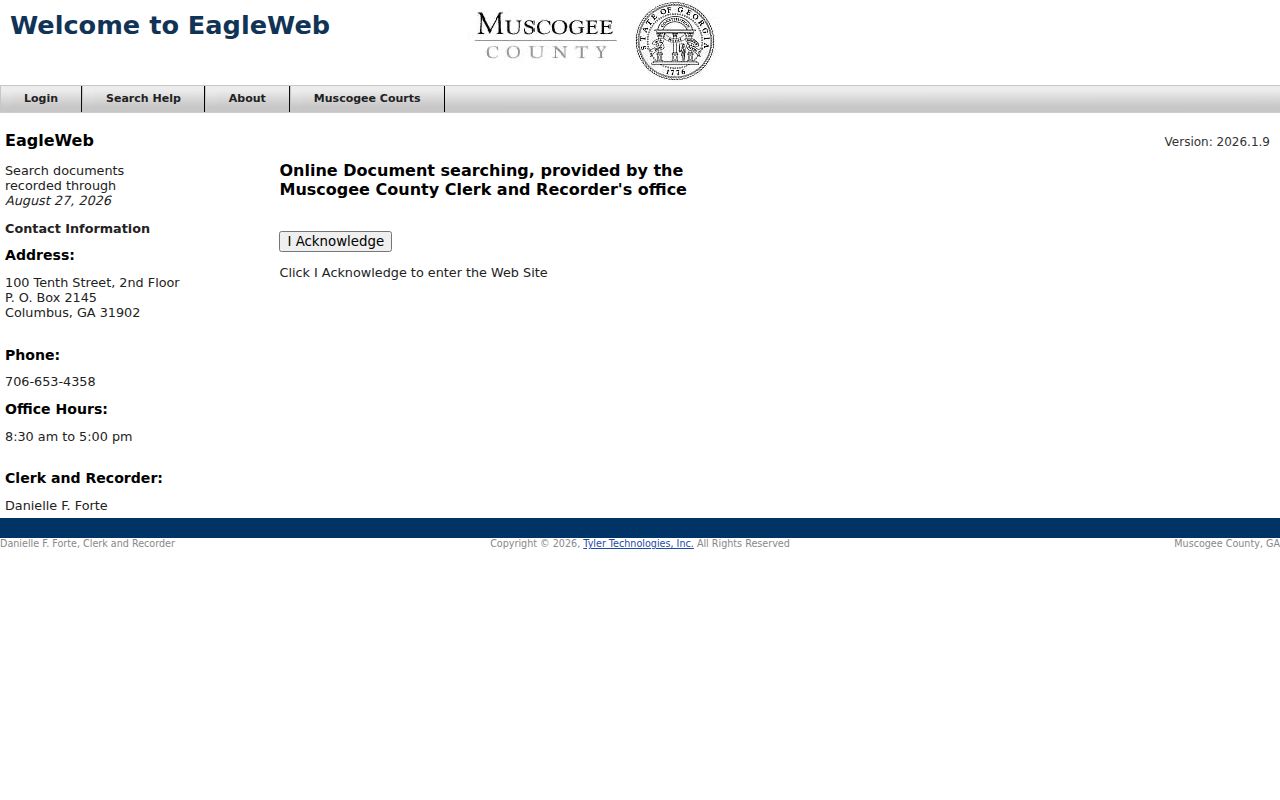
Pull party roles and recording references from the deed records index first. Then inspect or order the deed before adding any transfer to your chain of Muscogee County former owners.
How Far Muscogee Ownership Goes
A defensible online chain can start with property records from 1999 forward. That year is a statewide minimum for the online deed index. Not every Muscogee image begins there. Historical records keep being added. The exact local image cutover has not been published. To push the chain earlier, carry the last solid deed-book citation into the Clerk's books. From there, try Georgia Archives microfilm. Local archival holdings may hold the rest. The earliest county ownership may trace back to land grants and surveys. Those records tie to the county's 1825 formation.
Stop where the evidence stops. A gap may reflect an unscanned book or a spelling variant. It may also point to a different instrument series or a transfer through probate. It never justifies inventing an owner of record. Keep recorded title transfers separate from tax-roll and directory clues, and label unresolved years plainly.
Lawful use. Trace past ownership for house history, title work, or property diligence. Never use a living person's record to stalk, harass, or cause harm.