
Muscogee County Deed Types and What They Do
Several instruments move or burden land in Muscogee County. The Superior Court Clerk records them all. A warranty deed usually marks a true sale. A quitclaim deed gives up only whatever interest the signer might hold, no promises attached. Executor, administrator, and corrective deeds demand closer reading. Party capacity and references to earlier filings matter in those. A security deed, meanwhile, secures a debt rather than proving any transfer of ownership.
| Deed Type | What It Does | Common Use |
|---|---|---|
| Warranty deed | Conveys the described interest with deed covenants | Purchase or voluntary transfer |
| Quitclaim deed | Releases the grantor's stated interest | Clearing or changing a claim |
| Executor or administrator deed | Conveys land under estate authority | Probate-related transfer |
| Corrective deed | Corrects a prior recorded instrument | Name or description correction |
| Security deed | Secures an obligation against land | Financing record, not a sale |
Read the whole instrument before you decide what a deed actually changed. The index entry is only a locator. Signatures, acknowledgments, exhibits, prior-deed citations, legal descriptions, and party roles can all qualify what the short entry suggests. Treat stated consideration or transfer-tax figures as clues, not as an automatic market price.
Search the Muscogee Grantor-Grantee Index
Begin with the deed that gave the current owner the parcel. The buyer is the grantee. The seller is the grantor. That same grantor becomes your next name to hunt. Look for that name as a grantee in an even older deed. Before accepting any link, match the legal description, subdivision, block, lot, book and page, or reception number. Shared names can stitch together unrelated people.
The public Muscogee EagleWeb index supports Grantor, Grantee, and combined searches. It also covers recording dates, reception numbers, document types, and subdivision details. Basic name mode wants last-name-first entry. Advanced mode ignores name order and accepts wildcards plus include-or-exclude operators. That helps separate a prior owner from a stranger with a similar name.
| Index Field | Best Use | What to Preserve |
|---|---|---|
| Grantor or grantee | Locate a transfer by seller or buyer | Displayed name order and punctuation |
| Recording date | Narrow a broad party search | Filing date rather than deed date alone |
| Reception number | Return to one instrument | Every digit and separator |
| Document type | Separate deeds, liens, plats, and releases | The exact indexed type |
| Subdivision, block, lot | Search by recorded land identity | Letters, hyphens, and folio notation |
Note: EagleWeb renders results in its own screen layout, so confirm every index field against the recorded instrument itself.
Build a Muscogee Chain of Title
Reconstruct Muscogee County deed records as a sequence rather than a loose pile of names. Every step must carry the same land from one recorded transfer to the next. EagleWeb's Find Related function can surface instruments tied together by legal-description references. Subdivision, block, and lot searches fill the gap. An old deed may lack a street address.
- Locate the current owner's acquisition deed and verify the parcel description.
- Record the grantor, date, reception number, and book/page reference.
- Search that grantor as a grantee, then match the same legal description.
- Repeat until the index ends, then continue through deed books or microfilm.
- Grantor / grantee
- The transferring party and receiving party named in a deed.
- Chain of title
- The ordered run of conveyances affecting the same land.
- Legal description
- The recorded land identity that remains useful when an address changes.
Older Muscogee Deed Books Live Offline
The online index is not the county's full historical record of Muscogee County deed records. The Georgia Archives county-record collection holds microfilmed superior-court deed books and tax digests. Its county-card index works as a finding aid without images. Browsing by collection, record type, book, and page may be necessary. FamilySearch catalogs offer another route to filmed county material under its own access rules.
Columbus State University Archives adds court, tax, insurance, map, and manuscript holdings. The Betty Kinnett land-transactions collection, MC246, is a distinct lead for older land research. Chattahoochee Valley Libraries hold local directories, vital indexes, and obituary indexes. Many are on site. Some sit in the Digital Library of Georgia. The libraries publish no exact directory start and end years. Request a holdings check instead of assuming a full run.
Historic Columbus Names in Muscogee Deed Records
Jurisdiction names shift in Muscogee County deed records. The county formed in 1825. Harris County split away in 1827, and Columbus and Muscogee consolidated in 1971. Bibb City, chartered from 1909 to 2001, adds one more label you may meet in older material. Current searches run through Columbus Consolidated Government systems. Keep the jurisdiction exactly as each source printed it.
Streets and maps bridge those changes. Historic-preservation resources point to an 1885 Sanborn map, the 1926 Nolan plan, and a 1947 road plan. A directory can tie a person to an address for a given year, but that proves occupancy, not title. A map may explain a renamed street or a changed block. The deed's legal description remains the stronger ownership link.
Order a Muscogee Deed Copy
Index data identifies a candidate instrument; the deed image supplies the actual terms and legal description. GSCCCA offers statewide searching and paid image options. Its listed single-use access is $5 for four consecutive hours, with printing at $0.50 per page. Regular and premium monthly plans are also listed. Prices should be checked before purchase.
The Clerk's copy-request instructions provide an in-person and mail path. The mail form accepts grantor, grantee, property address, filing date, book, book type, page, and document type. In-person standard copies are listed at $1 per page. Certified and exemplified copies use a separate schedule, and mailed real-estate requests may take up to ten business days. Call the real-estate desk at 706-653-4358 if the book type or certification need is unclear.
See the Muscogee Deed Portal
The official EagleWeb entry screen separates public index access from registered image access.
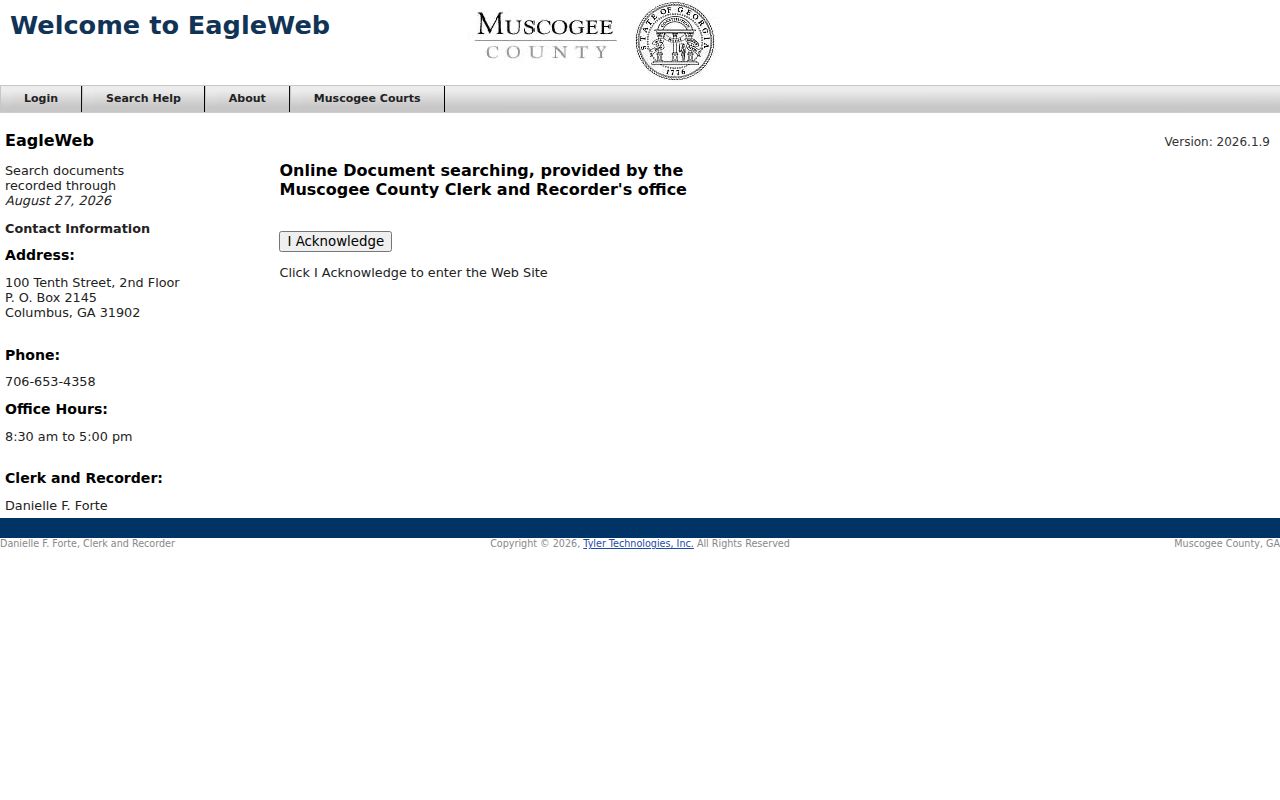
Pull party roles and recording references from the index first. Then open or order the Muscogee deed itself before you add any transfer to a chain of deeds.
Plats Anchor Muscogee Deed Descriptions
A plat is a recorded map of divided land. Deeds often say "according to plat," and that phrase is your roadmap. Capture the subdivision, phase, lot, block, plat book, page or folio, and recording date. EagleWeb lets you search by subdivision alone, subdivision plus block, or subdivision-block-lot. The portal accepts a colon for a lot range. But a range never substitutes for the exact lot that pins down the right parcel.
Columbus legal notices offer good search leads. Beverly Heights shows up as Lot 12, Block A, Plat Book 3, page 209. Rosemont Heights cites a plat recorded July 16, 1954, at Plat Book 11, page 58. Ranch Forest, Steam Mill Place, Lindsay Creek Park, Almark, Ridgeway Heights, and Weems Valley all prove the same point. Letters, hyphens, and folio labels must be copied exactly. Pull the recorded sheet itself to check easements, dedications, revisions, and any later replats.
Watch New Muscogee Deed Filings
The Filing Activity Notification System is called FANS. It sends free alerts when new filings match a name, address, or document type you register. Muscogee lists alert categories for real estate, UCC records, liens, and plats. It is a smart fraud watch after a purchase, estate transfer, or name change. It cannot rebuild the older chain, though.
An alert proves nothing by itself. Open the official instrument when a filing looks unfamiliar. Compare its parties and land description. Then call the Clerk through the published office number. A separate rule took effect January 1, 2025. The county's HB 1292 notice directs self-filers to submit real-estate documents through GSCCCA eFile after identity verification, subject to stated exceptions. The Clerk supplies no legal forms.
How Far Muscogee Deed Records Go
A solid online chain can start with records from 1999 forward. That date is a statewide minimum for the online deed index. It is not a promise that every Muscogee image begins there. Historical records keep being added, and the local image cutover has no published date. For earlier deeds, carry your last solid deed-book citation into the Clerk's books. Georgia Archives microfilm and local archival holdings extend the search further. Early county ownership can trace back to land grants and surveys tied to the county's 1825 formation.
Stop where the evidence stops. A gap may mean an unscanned book. It may also mean a spelling variant, a different instrument series, or a transfer through probate. It never justifies inventing an owner. Keep every recorded title transfer separate from tax-roll and directory clues. Label unresolved years plainly.
Use every access channel before calling anything a gap. The Clerk's Real Estate Recording and Records counter sits on the second floor of the Government Center at 100 Tenth Street, Columbus. The real-estate desk answers at 706-653-4358. Mail requests go to PO Box 2145, Columbus, Georgia 31902. For older work, the Georgia Archives microfilm index and the FamilySearch catalog allow volume-by-volume browsing. Columbus State University Archives and the Columbus Public Library genealogy collection hold maps, directories, court material, and local finding aids. Those sources explain names, dates, and place changes. The recorded instrument stays the title checkpoint. When a specific existing record does not come through the normal counter or copy process, send a focused Georgia Open Records Act request. Direct it to the office that holds it. Include the property description, party names, likely date range, instrument type, and any known book, page, or reception number. The custodian does not have to create a title abstract or a new compilation.
Lawful use. Trace past ownership for house history, title work, or property diligence. Never use a living person's record to stalk, harass, or cause harm.