
Find Out Who Owns Muscogee County Property
Three identifiers unlock the answer: site address, TaxPIN, and deed legal description. Columbus Consolidated Government Public Access provides the tax-roll lead. EagleWeb, the Superior Court Clerk's index, provides the recorded transfer. When one source runs stale, keep the dates visible. Then use the other Muscogee County property records channels.
- Search the Columbus property address in CCG Public Access and save every plausible parcel card.
- Match the site's TaxPIN, legal text, acreage, and map position, not just the street label.
- Search EagleWeb for the newest deed in which the named owner appears as grantee.
- Read the deed image or obtain a copy, then compare its legal description and recording date with the tax roll.
- For an entity, verify its official name and status in Georgia's business record; for an estate or trust, preserve the fiduciary role.
Turn a Columbus Address into a Muscogee TaxPIN
An address only locates land. It is not the legal identity of the parcel. Search the street number and name first, then test directionals, suffixes, unit numbers, and corner-street variants while you work. Commercial and multi-unit sites often share one tax parcel under a base address.
Copy the TaxPIN exactly as shown. Spaces and leading zeroes count. The county publishes no universal input format, and current GIS metadata treats the TaxPIN as a text field, so if the identifier fails, check the parcel layer for SplitFrom or CombinedFrom clues. A postal ZIP or mailing label proves nothing about subdivision identity or the exact parcel, so when two candidates share a street number, compare map position, acreage, legal text, and any lot or block reference. Save the rejected candidates and the reason.
Sources That Identify a Muscogee Property Owner
No single county screen proves every ownership fact. The assessor roll answers current facts fast. The deed is the recorded title checkpoint, GIS ties the identifiers to a shape, and state entity records decode an organizational grantee.
| Source | Owner Info It Gives | Access |
|---|---|---|
| CCG Public Access | Roll owner, situs and mailing clues, TaxPIN and assessment data | Online portal or Assessor staff |
| EagleWeb recorder index | Grantor, grantee, instrument, reception, book and page | Public index, Clerk counter, phone or mail |
| Georgia eCorp | Entity name, control number, agent and officers of record | State business search |
| CCG GIS | Parcel shape, TaxPIN and spatial context | Public map and ArcGIS services |
An occupant may hold no title at all. The person could be a relative, guest, or manager. Mailing addresses mislead too, since the county uses them for tax notices rather than ownership. Answer who owns from the tax roll and the deed, not from whoever appears at the building.
When Muscogee Public Access Is Unavailable
The owner-search route sometimes shows a maintenance message. That does not mean the record vanished. Use the CCG CurrentYear parcel and address-point layers, search EagleWeb by party or subdivision, or call the Board of Tax Assessors at 706-225-4398. The official CCG owner-search route remains the intended entry point for Muscogee County property records access once the system returns. The alternates above keep the property search moving.
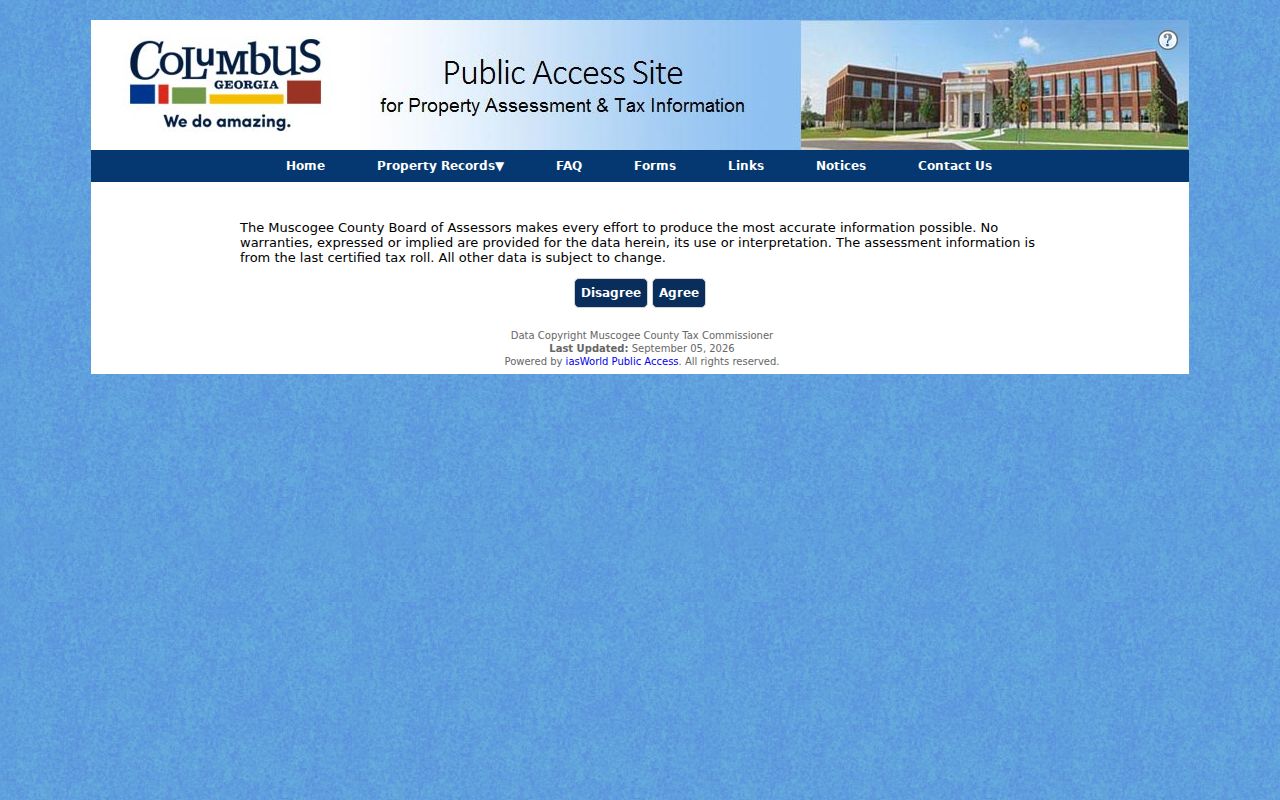
The maintenance notice reflects a temporary access condition. It is not a sample owner result, so it reveals nothing about missing fields or match behavior.
The Muscogee County Assessor sits at 3111 Citizens Way, Columbus. The office takes direct questions about parcels and the tax roll. For instrument references, the Real Estate Recording and Records Division answers at 706-653-4358 and serves customers at 100 Tenth Street, second floor.
Trace the Owner Answer to the Latest Deed
EagleWeb searches Grantor, Grantee, or both. Filter by date, reception number, or document type. Subdivision, block, and lot fields narrow it further. Use the assessor name as a grantee lead, then confirm the actual deed image. The legal description, prior deed reference, and vesting language outweigh any address. If online image access is limited, request a plain or certified copy from the Clerk with the book and page or reception number, parties, address, and document type. Mailed requests may take up to ten business days. A courthouse counter search still works when the web index falls short.
Read past the grantee line. A corrective deed can fix a description without changing the beneficial owner. A quitclaim conveys only what the grantor held. A fiduciary deed may name an executor or trustee. Follow "same property conveyed by" language and any plat reference until the described land matches.
The statewide GSCCCA index offers another deed-records channel. Its online coverage reaches back to January 1, 1999, with historical additions that vary. Older questions may need Clerk deed books. Georgia Archives microfilm and Columbus State University collections also help. Those sources add depth, but the immediate owner answer still rests on the newest controlling deed.
Decode LLC, Trust, and Estate Ownership
An LLC name answers ownership at the entity level. Georgia's eCorp search supports Starts With, Contains, and Exact Match. It accepts a business name or control number. Registered agents, officers, and designated agents work too. Match that exact legal name to the grantee and the TaxPIN.
- Owner of record
- The party named on the current tax roll or latest controlling deed.
- Grantee
- The party receiving the stated interest in a recorded instrument.
- Vesting
- The deed language describing how and in what role title is held.
- Situs address
- The location assigned to the parcel, distinct from the tax mailing address.
A registered agent receives official notices for an entity. The agent is not automatically the property's owner. Trust and estate deeds need the same care. Check whether the signer acts as a trustee, executor, or administrator.
Search entity names with punctuation and suffix variants. A tax-roll abbreviation may not match the deed index exactly. If a corporation merged or changed names, record the state filing that connects them. Never substitute the agent or officer for the grantee. The official business result supports identity; it does not itself convey land.
Account for Muscogee's January Roll Date
Muscogee County certifies its tax roll with an ownership date of January 1, 2026. That matters. A deed recorded the following week still names a newer grantee. The public property card can lag behind the recording. The Assessor publishes no figure for how long that lag runs. So line up four dates before drawing any conclusion. These are the deed date, the recording date, the roll date, and the day you checked.
This check keeps a stale answer from looking like a wrong one. Neither database is necessarily at fault. Confirm both records describe the same parcel number. Report the dates plainly. Ask the Assessor when the next roll update lands.
Watch Future Muscogee Filings with FANS
GSCCCA offers a free tool called the Filing Activity Notification System. FANS watches a name, an address, or a document category. It then sends notice of new filing activity. It works well as a follow-up on the owner of record. Verify that answer first through the deed records. This matters most when deed fraud or a surprise lien is the worry.
An alert is only a signal. It proves nothing about validity. Read the recorded image and reception number. Then contact the Clerk if the alert surprises you. FANS is not a title examination and should never stand in for one.
Note: FANS flags new filings but cannot say whether a filing is valid or tied to the right parcel.
Limits of “Who Owns This Property” Records
An owner of record answers one question only. It does not say who occupies the building. Nor does it reveal whether an unrecorded dispute lingers or whether title is clear. Protected addresses sit outside an ordinary Muscogee County property search. So do sealed court files and redacted personal or financial identifiers.
Georgia's Open Records Act gives you a path to an existing public file. Ask the right custodian and narrow the request by address, TaxPIN, record type, and date. The agency generally responds, provides the record, or explains a delay within three business days when practicable. It does not have to build a new ownership report for you.
Some records stay closed for good reason. Social Security numbers, financial-account data, protected addresses, and sealed material are not puzzles to reconstruct. If your sources disagree, pull the actual instruments. Do this when the conflict affects a purchase, an inheritance, or a boundary claim. Then seek qualified title help rather than stretching the search into unrelated personal records. The tax bill and the deed tell you plenty; they do not tell you everything.
Lawful use. Use Muscogee County owner information for legitimate property diligence, boundary questions, or record history. Never use it to stalk, harass, intimidate, or reconstruct protected data.